
Laparoscopic Gastric Surgery: A Guide to Minimally Invasive Stomach Procedures
Welcome to a center of excellence for modern, minimally invasive surgery. If you are exploring options for stomach surgery, whether for weight loss, cancer, or another condition, understanding the surgical technique is as important as understanding the procedure itself. Laparoscopic Gastric Surgery represents a revolution in surgical care, transforming major operations into procedures with less pain, smaller scars, and significantly faster recovery times. This comprehensive guide will explain this advanced approach and the wide range of stomach conditions it can be used to treat.
The success of any laparoscopic procedure is a direct reflection of the surgeon’s skill, precision, and experience with advanced technology. At our center, led by world-renowned surgeon Prof. Dr. Oguzhan Karatepe, we specialize in these state-of-the-art techniques. Our mission is to provide you with the most effective and least invasive treatment possible, combining surgical expertise with compassionate care to ensure the best possible outcome for your health.
Contact
Meet Prof. Dr. Oguzhan Karatepe: A Master of Laparoscopic Surgery
The field of minimally invasive surgery requires a surgeon with dedicated, specialized training and a profound understanding of advanced surgical technology. We are proud to have Prof. Dr. Oguzhan Karatepe, a world-class general surgeon, leading our team. With a distinguished career spanning over 25 years, Prof. Dr. Karatepe is a globally recognized pioneer and expert in performing complex Laparoscopic Gastric Surgery.
Prof. Dr. Karatepe’s authority in the field is underscored by his advanced training at world-leading institutions and his contribution of more than 100 prestigious national and international academic publications. He has dedicated his career to mastering the intricate skills required for minimally invasive procedures, from bariatric surgery to complex cancer resections. Patients from the USA, UK, Canada, Australia, and worldwide trust Prof. Dr. Karatepe for his meticulous technique, his ability to perform even the most demanding operations laparoscopically, and his commitment to providing a safer, faster recovery for his patients. When you choose our center, you are choosing a surgeon at the forefront of modern surgical innovation.
With over 25 years of experience, we perform these surgeries with expertise. Contact us now to find the best solution for your health.
Contact
What Is Laparoscopic Surgery? (The “Keyhole” Approach)
Laparoscopic surgery, also known as minimally invasive surgery (MIS) or “keyhole surgery,” is an advanced surgical technique that allows a surgeon to operate inside the abdomen and pelvis without having to make a large incision. In traditional “open” surgery, the surgeon must make a long cut to open the abdomen to see and work on the organs. In contrast, laparoscopic surgery avoids this completely.
The procedure works through a few key innovations:
- Small Incisions: The surgeon makes several small incisions, each typically only 5-10 millimeters in length.
- The Laparoscope: A laparoscope, which is a thin tube containing a high-definition camera and a light source, is inserted through one of the incisions. This transmits a magnified, detailed view of the inside of the abdomen onto high-resolution monitors in the operating room.
- Specialized Instruments: The surgeon inserts long, thin surgical instruments through the other small incisions. By watching the monitor, the surgeon can use these instruments to perform the entire operation with incredible precision.
This technique allows the surgeon to perform the same complex procedures as in open surgery, but with significantly less trauma to the body wall, muscles, and tissues.

The Advantages of Laparoscopic Gastric Surgery Over Open Surgery
Choosing a laparoscopic approach for your stomach surgery offers numerous, well-documented benefits that dramatically improve the patient experience and recovery process. The primary goal is to provide the same excellent surgical result as an open operation, but with significantly less impact on your body.
The key advantages include:
- Reduced Post-Operative Pain: Because there is no large incision cutting through layers of skin and muscle, patients experience significantly less pain after surgery.
- Smaller, More Cosmetic Scars: Instead of one long scar, you are left with a few tiny scars that are much less noticeable.
- Shorter Hospital Stay: Patients recover more quickly and are able to go home from the hospital sooner, often in half the time compared to open surgery.
- Faster Recovery and Return to Normal Activities: The reduced trauma to the body means you can get back to work, driving, and your daily life much more quickly.
- Lower Risk of Complications: Studies have shown that laparoscopic surgery has a lower risk of certain complications, such as wound infections and incisional hernias (hernias that develop in the surgical scar).
- Less Blood Loss: The magnified view and precise nature of the surgery often result in less bleeding during the operation.
Contact
Applications: Common Types of Laparoscopic Gastric Surgery
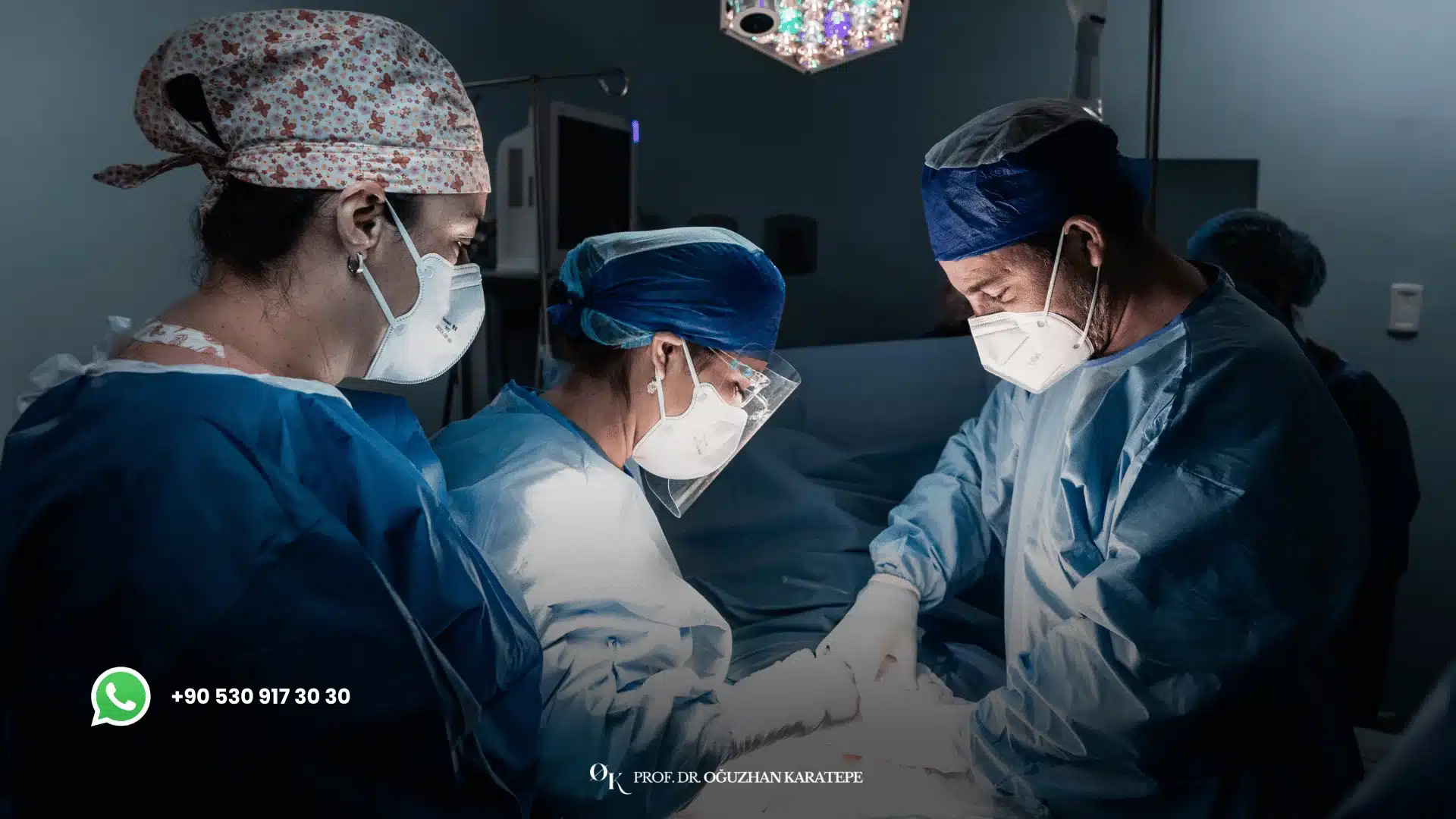
Thanks to advancements in technology and surgical skill, the vast majority of stomach operations can now be performed laparoscopically. As a specialist in this field, Prof. Dr. Karatepe performs a wide range of these procedures.
Laparoscopic Bariatric (Weight Loss) Surgery
Laparoscopy has revolutionized the field of bariatric surgery, making it safer and more accessible. The two most common weight loss procedures are performed laparoscopically:
- Laparoscopic Sleeve Gastrectomy: This is currently the most popular weight loss surgery worldwide. The surgeon removes about 80% of the stomach, creating a small “sleeve.” This procedure is performed entirely through small incisions, leading to a recovery time of just a few weeks.
- Laparoscopic Gastric Bypass: This “gold standard” procedure involves creating a small stomach pouch and rerouting the intestines. Performing this complex reconstruction laparoscopically requires a high degree of skill but offers patients all the benefits of a faster, less painful recovery.
Laparoscopic Gastric Surgery for Cancer
Performing cancer surgery laparoscopically is one of the most demanding surgical challenges. It requires a surgeon to not only remove the organ but also to perform a meticulous and extensive lymph node dissection, all through small incisions. In the hands of an expert surgical oncologist like Prof. Dr. Karatepe, this is achievable and offers immense benefits to the patient.
- Laparoscopic Partial & Total Gastrectomy: The removal of part or all of the stomach for stomach cancer can be performed laparoscopically. This includes the essential **D2 lymphadenectomy**, where all the lymph node groups around the stomach are carefully removed. This allows patients recovering from a major cancer operation to have less pain and a quicker start to any needed post-operative chemotherapy.
Contact
Laparoscopic Surgery for Gastroesophageal Reflux Disease (GERD)
For patients with severe, chronic acid reflux that is not well-controlled with medication, or those with a large hiatal hernia, laparoscopic surgery offers a definitive cure.
- Laparoscopic Nissen Fundoplication: This is the standard anti-reflux surgery. The surgeon wraps the top part of the stomach (the fundus) around the lower esophagus to recreate the valve that prevents acid from splashing up. Performing this laparoscopically means a quick recovery from a procedure that provides lasting relief from heartburn and regurgitation.
Who Is a Candidate for a Laparoscopic Approach?
Today, most patients needing gastric surgery are candidates for a laparoscopic approach. The decision is based on several factors, including:
- The Specific Procedure: Most standard gastric procedures are now routinely performed laparoscopically.
- The Patient’s Anatomy and Body Habitus: While being overweight is not a barrier (especially for bariatric surgery), certain anatomical factors are considered.
- The Extent of the Disease (for cancer): For very large tumors or those that have invaded surrounding structures, an open approach may sometimes be safer and more effective.
- Previous Surgeries: Patients with extensive scar tissue (adhesions) from multiple previous open abdominal surgeries may not be candidates, as it can be difficult to safely navigate inside the abdomen with laparoscopic instruments.
It is important to note that the surgeon’s skill and experience are critical. A highly experienced laparoscopic surgeon can safely perform procedures on patients that a less experienced surgeon might only attempt with an open incision. Prof. Dr. Karatepe’s expertise significantly expands the number of patients who can benefit from a minimally invasive approach.
Contact
The Role of Robotic Surgery: The Next Frontier
Robotic-assisted surgery is the most advanced form of minimally invasive surgery. In this approach, the surgeon sits at a console and controls robotic arms that hold the surgical instruments. The robotic platform provides several key advantages over traditional laparoscopy:
- 3D High-Definition Vision: Providing the surgeon with unparalleled depth perception and a crystal-clear view of the operative field.
- Enhanced Dexterity and Precision: The robotic instruments have “wrists” that can rotate 360 degrees, far exceeding the range of motion of the human wrist.
- Tremor Filtration: The system filters out any tiny, natural hand tremors, increasing the stability and precision of the movements.
This technology allows surgeons like Prof. Dr. Karatepe to perform the most complex and delicate gastric procedures with an even higher degree of precision, which can translate into better outcomes and safer operations for the patient.
Key Takeaways
- The Modern Standard of Care: Laparoscopic Gastric Surgery is the modern, minimally invasive approach to most stomach operations.
- Significant Patient Benefits: The key advantages are less pain, smaller scars, a shorter hospital stay, and a much faster overall recovery.
- Wide Range of Applications: This technique is used for bariatric surgery (sleeve, bypass), cancer surgery (gastrectomy), and anti-reflux surgery.
- Expertise is Paramount: The ability to perform complex procedures laparoscopically depends entirely on the surgeon’s advanced training and experience.
- Robotic Surgery is the Next Step: Robotic-assisted surgery offers even greater precision and control for the most demanding gastric procedures.
Contact

Your Next Step: A Consultation with a Laparoscopic Expert
You have now learned about the significant benefits of a modern, minimally invasive approach to stomach surgery. Whether you are considering surgery for weight loss, cancer, or reflux, you deserve the safest, least painful, and most effective procedure available. The key to accessing this level of care is choosing a surgeon who is a true master of Laparoscopic Gastric Surgery.
Prof. Dr. Oguzhan Karatepe has dedicated his over 25 years of experience to being at the forefront of these advanced techniques. He has helped hundreds of patients from around the world benefit from a faster and smoother recovery. Our team is committed to providing a level of care that combines this world-class technical skill with the compassionate, supportive environment you need to feel confident in your treatment plan.
The next step is to find out if a minimally invasive solution is the right path for you.
Contact us now to arrange a confidential consultation. Let us review your case and provide the clear, authoritative answers you need to make the best decision for your health and well-being. Join the hundreds of patients who trusted our expertise.
Contact
Frequently Asked Questions (FAQ) About Laparoscopic Gastric Surgery
Basics of Laparoscopic Surgery
1. What is laparoscopic surgery?
It is a type of minimally invasive surgery where the surgeon operates through several small incisions using a camera (laparoscope) and long, specialized instruments.
2. What is another name for laparoscopic surgery?
It is often called “minimally invasive surgery” (MIS) or “keyhole surgery.”
3. How is it different from open surgery?
Open surgery uses one long incision to open up the abdomen. Laparoscopic surgery uses several tiny incisions, avoiding a large cut through the muscles.
4. Is laparoscopic surgery safe?
Yes, it is extremely safe. For most procedures, it is considered as safe or safer than traditional open surgery, with a lower risk of certain complications.
5. What are the main benefits?
The main benefits are significantly less pain, smaller scars, a shorter hospital stay, and a much faster recovery.
6. How small are the incisions?
The incisions are typically between 5 and 12 millimeters (about 1/4 to 1/2 inch) in length.
7. Will I have a scar?
Yes, you will have several small scars, but they are far more cosmetic and less noticeable than the single large scar from open surgery.
8. What is a laparoscope?
It is a thin, tube-like instrument with a high-definition camera and a light source on the end that allows the surgeon to see inside your abdomen on a monitor.
9. What are trocars?
Trocars are hollow tubes that are inserted through the small incisions. They act as ports through which the surgeon passes the laparoscope and instruments.
10. Does the surgeon see what they are doing?
Yes, they have a magnified, high-definition view of the operative field on large monitors in the operating room, which is often better than what can be seen with the naked eye.
Contact
Applications in Gastric Surgery
11. What types of stomach surgery can be done laparoscopically?
Nearly all types, including bariatric surgery (sleeve, bypass), surgery for stomach cancer (gastrectomy), and surgery for acid reflux (fundoplication).
12. Can a gastric sleeve be done laparoscopically?
Yes, virtually 100% of gastric sleeve procedures are now performed laparoscopically.
13. Can a gastric bypass be done laparoscopically?
Yes, this complex procedure is routinely performed laparoscopically by experienced bariatric surgeons.
14. Can stomach cancer surgery be done laparoscopically?
Yes, in the hands of an expert surgical oncologist, both partial and total gastrectomies with the necessary lymph node removal can be performed laparoscopically.
15. Is it safe to perform cancer surgery laparoscopically?
Yes, studies have shown that for appropriate patients, laparoscopic gastrectomy for cancer is just as effective as open surgery in terms of cancer outcomes, but with the added benefits of a faster recovery.
16. What about surgery for acid reflux (GERD)?
The standard anti-reflux surgery, a Nissen fundoplication, is almost always performed laparoscopically.
17. Can a perforated ulcer be fixed laparoscopically?
Yes, in many cases, emergency surgery for a perforated ulcer can be repaired using a laparoscopic approach.
18. Can a stomach tumor be removed laparoscopically?
Yes, depending on the size, type, and location of the tumor, it can often be removed with minimally invasive techniques.
19. Can very large tumors be removed laparoscopically?
For very large or invasive tumors, an open approach may be safer or more effective. This is a decision made by the expert surgeon.
20. Why is an expert surgeon important for laparoscopic gastric surgery?
Because these are technically demanding procedures. The surgeon’s skill directly impacts the safety of the operation and the patient’s ability to receive a minimally invasive procedure.
Contact
Candidacy and Contraindications
21. Is everyone a candidate for laparoscopic surgery?
Most patients are, but there are some exceptions.
22. What would prevent me from having a laparoscopic surgery?
The most common reasons are extremely dense scar tissue from multiple previous open surgeries, or a tumor that is too large or has invaded surrounding structures.
23. Can I have laparoscopic surgery if I am very overweight?
Yes. Laparoscopic surgery is the standard for bariatric (weight loss) surgery, which is performed exclusively on patients who are overweight.
24. What if I have had a C-section before?
A previous C-section does not prevent you from having a laparoscopic gastric surgery.
25. What if I have had my appendix or gallbladder out laparoscopically?
This also does not prevent you from having another laparoscopic procedure.
26. Can the surgeon switch from laparoscopic to open during the operation?
Yes. While rare (less than 1-2% of cases for experienced surgeons), the surgeon can always convert to an open procedure if they determine it is the safest option for the patient.
27. What is the main reason for converting to an open surgery?
The most common reason is extensive scar tissue (adhesions) that prevents the surgeon from safely seeing and dissecting the necessary organs.
28. Is having a laparoscopic surgery better for elderly patients?
Yes, the reduced stress on the body from a minimally invasive approach can be particularly beneficial for older patients.
29. How is the decision made to do laparoscopic vs. open?
It is based on a combination of the patient’s condition, their surgical history, and the surgeon’s expertise and judgment.
30. Does an experienced surgeon do more cases laparoscopically?
Yes, a surgeon with advanced laparoscopic skills can safely perform a wider range of complex cases minimally invasively.
Recovery and What to Expect
31. How long is the recovery after laparoscopic gastric surgery?
Recovery is much faster than with open surgery. You can often expect to be back to most normal activities within 2-4 weeks.
32. How long is the hospital stay?
This depends on the procedure, but it is much shorter. For a sleeve gastrectomy, it might be 1-2 nights. For a laparoscopic Whipple, it might be 5-7 days (compared to 10-14 for an open one).
33. Will I have less pain?
Yes, patients consistently report significantly less pain and require less pain medication after laparoscopic surgery.
34. What are the scars like?
You will have several small scars, usually 3 to 5, that are each about half an inch long. They fade very well over time.
35. When can I shower?
You can typically shower within a day or two after the surgery.
36. When can I drive?
You should not drive until you are completely off narcotic pain medication and can move comfortably, usually within 1-2 weeks.
37. What are my activity restrictions?
You will be encouraged to walk immediately. You should avoid any heavy lifting (more than 10 lbs / 5 kg) for about 4-6 weeks.
38. Is the risk of a hernia lower?
Yes, the risk of developing an incisional hernia (a hernia in the scar) is much lower with laparoscopic surgery compared to a large open incision.
39. Is the risk of infection lower?
Yes, the risk of wound infection is significantly lower with small laparoscopic incisions.
40. How is the organ or stomach removed from the body?
One of the small incisions is slightly enlarged at the end of the procedure just enough to safely remove the specimen.
Contact
Robotic Surgery
41. What is robotic surgery?
Robotic surgery is the most advanced form of laparoscopic surgery where the surgeon operates by controlling robotic arms from a console.
42. Is the robot doing the surgery?
No, absolutely not. The surgeon is in 100% control at all times. The robot is a tool that translates the surgeon’s movements into very precise actions.
43. What are the main advantages of using a robot?
The main advantages for the surgeon are magnified 3D vision, wristed instruments that have a greater range of motion than the human hand, and elimination of hand tremors.
44. Does this translate to benefits for the patient?
Yes, for very complex procedures like a gastrectomy for cancer, the enhanced precision can lead to a safer operation with less blood loss and potentially better outcomes.
45. Is robotic surgery available for all gastric procedures?
It can be used for nearly all of them, but it is most beneficial for the most complex reconstructive parts of a surgery, like a gastric bypass or gastrectomy.
46. Is robotic surgery more expensive?
The technology is expensive, so the procedure can sometimes cost more. However, this may be offset by a shorter hospital stay.
47. Is the recovery from robotic surgery even faster?
The recovery is similar to standard laparoscopic surgery, as the incisions are the same size. The main benefits are related to the precision of the internal operation.
48. Does Prof. Dr. Karatepe perform robotic surgery?
Yes, as a leader in minimally invasive techniques, he is skilled in using the robotic platform for advanced gastric surgery.
49. Is robotic surgery the future?
It is certainly a major part of the future of surgery and is becoming more common for complex procedures every year.
50. How do I know if robotic surgery is right for me?
This is a decision made with your surgeon, who will determine the best and safest technical approach for your specific condition.
Miscellaneous Questions
51. What does “gastric” mean?
Gastric is the medical term for anything related to the stomach.
52. What gas is used to inflate the abdomen?
Carbon dioxide (CO2) is used. It is very safe and is absorbed and expelled naturally by the body.
53. Does the gas cause pain after surgery?
Some patients experience some shoulder pain for a day or two after surgery. This is referred pain from the gas irritating the diaphragm and it resolves quickly.
54. How long does a laparoscopic gastrectomy take?
It is a long and complex operation, and can take 3-5 hours.
55. How long does a laparoscopic sleeve gastrectomy take?
This is a much simpler procedure, usually taking only 60-90 minutes.
56. What if I have a lot of scar tissue?
This is called adhesions. An experienced surgeon can often work through adhesions laparoscopically, but sometimes it requires converting to an open procedure.
57. What is the difference between laparoscopy and endoscopy?
Laparoscopy looks at the outside of the organs from inside the abdominal cavity. Endoscopy (gastroscopy) looks at the inside lining of the organs by passing a camera through the mouth.
58. Will I have a drain after my surgery?
For some more complex procedures like a gastrectomy, a temporary surgical drain may be left in place for a few days.
59. Can I get pregnant after laparoscopic gastric surgery?
Yes. The surgical technique does not affect your ability to get pregnant. You would need to follow specific advice based on the type of operation (e.g., waiting after bariatric surgery).
60. Why is walking so important after surgery?
Walking helps prevent blood clots, improves lung function, and helps your digestive system “wake up” faster.
61. What if I feel nauseous after surgery?
Nausea is common, and your team will have effective anti-nausea medications to keep you comfortable.
62. Is it possible to damage organs with the instruments?
While a potential risk, it is extremely rare in the hands of a skilled laparoscopic surgeon who has a clear, magnified view of the anatomy.
63. Can I choose to have an open surgery instead?
For most procedures, the laparoscopic approach is now the standard of care due to its proven benefits. An open approach is reserved for specific clinical reasons.
64. Does a laparoscopic approach compromise a cancer operation?
No. Decades of research have shown that when performed by an expert, a laparoscopic gastrectomy for cancer is oncologically equivalent to an open one, with all the benefits of a faster recovery.
Contact
65. How long has laparoscopic surgery been around?
Laparoscopic gallbladder removal became common in the early 1990s. The techniques have been refined and applied to more complex procedures over the last 30 years.
66. What is the most important factor in a successful laparoscopic surgery?
The skill and experience of the surgeon.
67. Will my insurance cover laparoscopic surgery?
Yes, laparoscopic surgery is the standard of care and is covered by insurance just as open surgery would be.
68. Why would a surgeon choose to do an open surgery?
For safety. If a tumor is extremely large, invading other organs, or if there are dense adhesions, an open approach may provide better control and be safer for the patient.
69. How many incisions will I have?
This depends on the procedure, but typically between 3 and 6 small incisions.
70. Will I have stitches or glue on the incisions?
Both are used. Often there are dissolvable stitches under the skin and surgical glue on the outside.
71. When can I get the incisions wet?
You can typically shower 24-48 hours after surgery, but you should not soak in a bath or pool for a few weeks.
72. What are the signs of a wound infection?
Signs include increasing redness, swelling, pain at the incision site, or any drainage from the wound.
73. What is a “hand-assisted” laparoscopic surgery?
This is a hybrid technique where the surgeon makes a slightly larger incision to insert one hand into the abdomen to assist with the operation, while still using laparoscopic instruments.
74. Is it harder for the surgeon to do it laparoscopically?
Yes, it is more technically demanding for the surgeon and requires a significant amount of specialized training and practice to master.
75. How can I find a good laparoscopic surgeon?
Look for a surgeon who is fellowship-trained in minimally invasive surgery and who performs a high volume of the specific procedure you need.
76. What is the biggest advantage for the patient?
Most patients would say that the significantly reduced pain and faster return to their normal life are the biggest benefits.
77. Do I need a special diet after laparoscopic surgery?
The type of surgery determines the diet, not the technique. A laparoscopic gastrectomy requires the same special diet as an open one.
78. Will I lose more weight with a laparoscopic bariatric surgery?
No, the weight loss results are the same as with an open procedure. The benefit is in the recovery.
79. Can you remove the whole stomach laparoscopically?
Yes, an expert surgeon can perform a total gastrectomy laparoscopically.
80. How does the surgeon’s hand feel the tissue?
This is a key difference. In open surgery, the surgeon can feel the tissue directly. In laparoscopic surgery, they rely on “haptic feedback” through the instruments and their expert visual assessment.
81. Is there anything I can do to make my recovery faster?
Yes. The most important thing is to get up and walk as soon as possible and as much as possible after your surgery.
82. Is there more risk of a leak with laparoscopic surgery?
No. In the hands of an experienced surgeon, the risk of a leak from a new connection is the same as with open surgery.
83. What if I have a complication? Can it be managed laparoscopically?
Sometimes, yes. But often, if a major complication occurs, a conversion to an open surgery may be needed to fix it safely.
84. What does “ambulation” mean?
This is the medical term for walking, and it is the key to preventing post-operative complications like pneumonia and blood clots.
85. Will I be intubated?
Yes, all general anesthesia involves placing a breathing tube (intubation) which is removed before you wake up.
86. What is the first step to see if I am a candidate?
The first step is a consultation with an expert surgeon to review your case and discuss the best approach for you.
87. Why choose Prof. Dr. Karatepe for my laparoscopic surgery?
His 25+ years of experience and specialization in advanced minimally invasive techniques ensure you are getting care from a surgeon at the top of his field.
88. What is the future of gastric surgery?
The future is focused on even less invasive techniques, including robotic surgery and endoscopic procedures performed entirely through the mouth.
89. Will I be able to see a video of my surgery?
The surgery is recorded. While not routine, you can certainly ask your surgeon if it’s possible to see images.
90. Are the instruments reusable?
Some instruments are reusable after extensive sterilization, while others, like stapling devices, are single-use.
91. How does the camera stay clean?
The camera has a lens warmer to prevent fogging, and the surgical team can clean it during the procedure if needed.
92. Is there a “best” type of surgery?
The best type of surgery is the one that is safest and most effective for your specific condition, performed by an expert surgeon.
93. What is SILS?
Single Incision Laparoscopic Surgery (SILS) is a technique where the surgeon operates through just one small incision, usually in the belly button.
94. Is SILS better?
It offers a potential cosmetic benefit (a single hidden scar), but it is more technically challenging and is not suitable for all procedures.
95. What is the most common laparoscopic gastric surgery?
Worldwide, laparoscopic cholecystectomy (gallbladder removal) is the most common, but for the stomach itself, it would be bariatric procedures like the sleeve gastrectomy.
96. Does this approach cost more?
The operative time may be longer, but the shorter hospital stay often balances out the cost, making it equivalent to open surgery for many healthcare systems.
97. Will I have to stay on my back after surgery?
No, the nurses will help you change positions and get you sitting in a chair and walking as soon as possible.
98. What if I am claustrophobic?
The feeling of being “inflated” with gas is not something you are aware of while under anesthesia. It should not be a problem.
99. What is the most important question to ask my surgeon?
“How many of this specific laparoscopic procedure do you perform each year?” Experience is the key to safety and success.
100. I’m interested in a minimally invasive approach. What should I do?
Contact our team for a consultation. We can review your case and determine if you are a candidate for a state-of-the-art laparoscopic gastric surgery.
Contact
References
We base our practice and information on the highest standards set by leading global medical authorities and surgical societies. The content on this page is informed by:
- SAGES (Society of American Gastrointestinal and Endoscopic Surgeons). (n.d.). Patient Information for Laparoscopic Surgery. https://www.sages.org/patient-information-for-laparoscopic-surgery/
- Cleveland Clinic. (n.d.). Laparoscopic Surgery. https://my.clevelandclinic.org/health/treatments/21192-laparoscopic-surgery
- Johns Hopkins Medicine. (n.d.). Minimally Invasive Surgery. https://www.hopkinsmedicine.org/health/treatment-tests-and-therapies/minimally-invasive-surgery
Please note: This information is for general purposes only. For personalized treatment advice, please contact us directly.